


Secondary Packaging and End of Line Automation: A Strategic Investment for Modern Manufacturing
In today’s manufacturing environment, secondary packaging and end of line automation are no longer secondary considerations. They play a central role in determining operational efficiency, product quality, and long term competitiveness.
Companies that modernize their end-of-line operations see measurable improvements: higher productivity, lower operating costs, improved safety standards, and more consistent output. In fast-moving markets, these advantages are not incremental they are decisive.
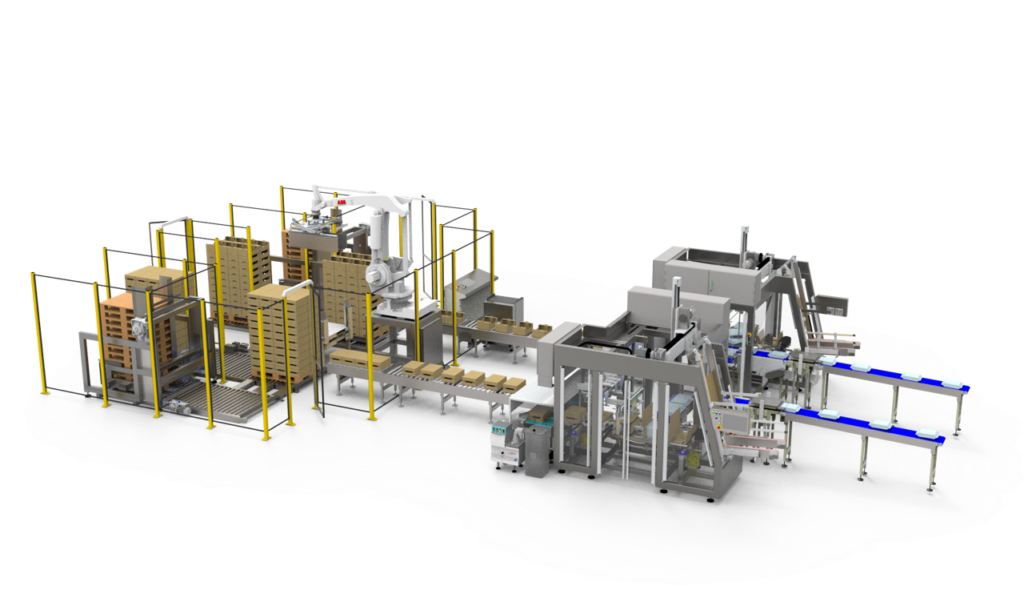
Why End of Line Automation Matters
The end of the production line is where efficiency either holds together or falls apart.
Automated end of line systems ensure:
• Accurate case packing and sealing
• Consistent product positioning
• Precise pallet patterns
• Reduced handling errors
The impact is immediate: fewer rejects, fewer returns, less product damage during transport, and stronger quality control.
Beyond performance, automation also reduces repetitive and physically demanding tasks for operators, contributing to a safer and more compliant work environment.
The Role of Secondary Packaging
Secondary packaging includes all operations that follow primary packaging case packing, sealing, labeling, weight control, and palletizing.
This stage forms the bridge between production and logistics. When optimized, it protects the product, improves warehouse flow, and enhances the customer’s perception of quality. When neglected, it becomes a bottleneck.
Manual processes or outdated equipment can slow down the entire production line and limit scalability. That’s why companies focused on growth increasingly prioritize this area.
Tiber Pack: Engineering Efficiency Since 1968
Since 1968, Tiber Pack has specialized in end of line automation, designing and manufacturing reliable, high-performance systems built to last.
The company’s secondary packaging solutions integrate advanced technologies and intelligent software to meet the demands of flexible production environments. Systems are designed to manage multiple product formats with fast, guided changeovers reducing downtime and maximizing line efficiency.
This level of flexibility is particularly valuable for:
• Private label producers
• Companies with diversified product ranges
• Manufacturers operating in fast-changing markets
Adaptability is no longer optional it is a competitive advantage.
Questa flessibilità è particolarmente importante per aziende che operano nel mondo delle private label o per realtà con ampie gamme di prodotto, dove la capacità di adattarsi rapidamente alle richieste del mercato rappresenta un vantaggio competitivo concreto.
But what truly differentiates Tiber Pack is its long term approach. The relationship does not end with installation. Comprehensive after-sales support includes remote assistance, rapid technical interventions, spare parts management, new format development, and preventive maintenance programs.
The objective is simple: keep your end-of-line running at peak performance over time.
Automation as a Critical Success Factor
Shorter lead times. Smaller production batches. Higher quality expectations.
These are the realities of modern manufacturing.
Investing in automated secondary packaging is not just about speed. It’s about building a production system that is efficient, reliable, and ready to scale.
Companies that strengthen their end-of-line operations gain flexibility, reduce operational risks, and position themselves for sustainable growth.
In today’s competitive industrial landscape, end of line automation is no longer a technical upgrade it’s a strategic decision.
And increasingly, it’s a necessary one.
No comment yet, add your voice below!